
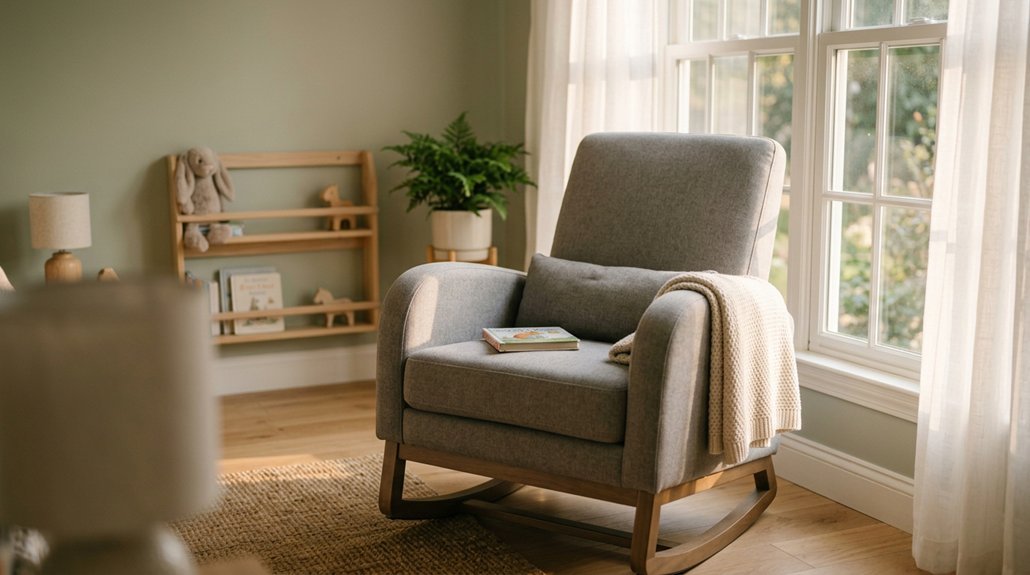


You might assume a glider chair is just another rocking chair, but the two move in completely different ways.
A glider stays flat on the floor while it slides back and forth on a fixed track, giving you steady, controlled motion without tipping or balancing.
This design makes it ideal for small spaces, nursing, or anyone who wants smooth movement without the jerk of traditional rockers.
What Is a Glider Chair and How Does It Move?
How exactly does a glider chair move, and what sets it apart from the rocker you might already know? A Glider Chair slides in a smooth gliding motion along a fixed track while its base stays flat on your floor. You’ll notice the back-and-forth motion feels steadier than a rocker’s arc, since the seat travels forward and backward rather than tipping.
This movement comes from a double-rocker four-bar linkage, a set of metal bars connecting the seat frame to the base. The mechanism guides your chair in a level, near-linear path, more like a drawer sliding open than a boat rocking on waves. You get a gentle glide without the jerky starts or sudden stops you’d feel in traditional rocking motion.
Recommended Products

Replacement DuraGlide glider mechanism.

FITS MOST STANDARD CHAIRS (11mm STEM) Compatible with office chairs, gaming chairs, school chairs, and desk chairs that use a 7/16" (11mm) x 22mm stem. Not compatible with IKEA chairs (10mm stem).
Glider vs. Rocker vs. Recliner: Which Motion Fits Your Life?
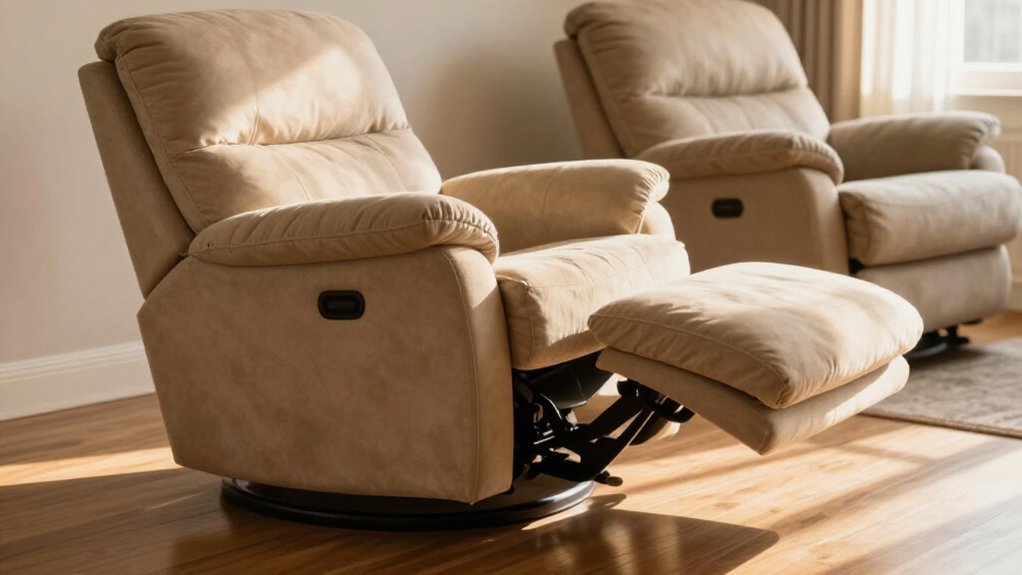
Where exactly does each chair fit into your daily routine, and which motion will actually serve you best? When you compare Glider vs rocking options, you’ll notice each chair motion serves different needs.
Traditional rocking chairs vs Rocking Chair designs move back and forth on curved runners, creating an arc that depends on your balance and momentum. You might feel less control when shifting positions.
Rocking chairs arc on curved runners, demanding balance and momentum, leaving you less steady when you shift.
Glider chairs offer smooth pivot movement on a fixed track instead. You’ll experience quiet operation with a gentle, linear slide, closer to a drawer opening than a swing. This gives you continuous motion without tipping, a common concern with arc-based rockers.
Recliners adjust your body position through back and footrest changes, not rhythmic movement. You choose them when posture support matters more than motion.
Postpartum households, readers, and older adults often prefer gliders for calmer, predictable movement.
Recommended Products

Cozy Glider Chair: Our single-person outdoor glider features a 28-inch-high backrest and ergonomically protruding neck support, providing your upper body extra comfort.

Cozy Glider Chair Set of 2: Our single-person outdoor glider features a 28-inch-high backrest and ergonomically protruding neck support, providing your upper body extra comfort.

Relax with daVinci Glider Nursery Chair with Storage Ottoman: Enjoy comfort with a high back, back-and-forth gliding motion, and smooth 360° swivel. The ottoman with storage provides space for baby essentials, combining relaxation with practical storage.
Who Needs a Glider Most? (Beyond the Nursery)

The comparison of chair motions points to a broader question: who actually benefits from a glider’s steady, level movement once you move past the nursery? You might choose gliders if you deal with back pain, since gentle motion on a fixed base creates less spinal stress than an arcing rocker. Older adults and anyone with balance concerns find gliders safer because the fixed base stays planted while the seat glides.
You may also weigh a glider or a rocker for long periods of reading or relaxing. Look for lumbar support and sturdy armrests if you’re furnishing for aging parents. Some models handle 225 pounds across 100,000 cycles, giving you durable comfort well past the nursery years.
Recommended Products
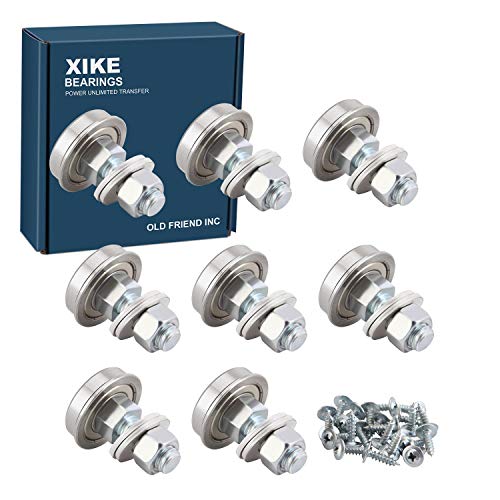
✔ Simple - quick Installation to repair and new works.

Core Replacement: This rocking chair bearing is made for replacing old or broken rocking chair bearing parts, helping restore chair movement and support normal use; the connecting fitting design works with furniture hardware bearing applications and is suitable for rocking chair repair needs

Steel Mechanism for Swivel Rocking Chairs with 4 SPRINGS.
Where Gliders Work Best: Room-by-Room Placement
In any room, you’re placing more than a chair; you’re positioning a tool for daily movement. Glider chairs suit nurseries where you need that calm, controlled movement for midnight feedings, unlike rocking chairs offer with their arcing motion. The flat base and fixed track let you keep your back supported without curved legs tipping or shifting.
In living room quiet corners, you position the seat with clearance behind it, since the base stays planted while the seat glides forward. Bedrooms work well postpartum because the gentle stops and starts feel comfortable for extended rest.
For aging parents, you choose flat, stable-glide spots where armrests and steady bases reduce coordination needs. In open rooms, you plan around the smooth linear travel, even with swivel models, so the continuous motion stays unblocked.
Recommended Products

【Comfortable Support Relieves Fatigue】 - The HAVARGO 2-in-1 comfortable lumbar support cushion is made with soft, resilient high-density foam that naturally conforms to the curve of your spine. It cradles your back and neck when lying on a sofa or recliner, helping distribute pressure, reduce neck and shoulder stiffness, and make your rest more relaxing.

Superior Comfort: Enjoy personalized comfort with electric reclining from 120° to 145°.The electrically adjustable headrest and manually adjustable armrests provide customized support for your neck and arms. The electric lumbar support cushion offers targeted lower back relief, reducing fatigue during long sitting sessions

For convenience and durability, we upgraded and lengthened the straps to fit more chairs instead of adding extra extension straps.
How to Customize a Glider You’ll Keep for Years
Because you’ll spend hours in this chair, you need to pick features that fit your body, not just your room. Custom furniture lets you shape this glider around your daily life, not just your nursery months.
See rounded arms cradling your elbows, or clean lines matching your modern living room years later. Think of the seat depth holding your legs fully, not perching you forward, with fabric or leather-look upholstery you’ll still want to touch daily. Envision yourself swiveling toward conversation in an open layout, the gentle movement still smooth after thousands of uses.
Solid wood frames and precision steel bearings, tested to 225 lb over 100,000 cycles, deliver long-term value. Quality motion seating means lifetime-warrantied hardware for quiet, controlled movement you’ll trust every evening.
Recommended Products

【Comfort and Relaxation】This nursery rocking chair features a 6.3-inch thick high-density foam seat cushion that is soft and supportive, making it ideal for extended reading, watching TV, browsing phone, napping, or knitting. Combined with a scientifically designed gentle rocking frequency, it helps to soothe the baby to sleep in your arms, relieve postpartum anxiety, or alleviate work stress. Note: Cushion is vacuum-compressed; fluffs to 80% in 1-2 hours, full in 24h.

ERGONOMIC ENOUGH: SAETSFEG baby rocking chair nursery incorporates ergonomic design principles, aiming to alleviate fatigue and provide a comfortable environment to some extent. The armrests are positioned optimally, and the overall swinging motion offers the best experience while ensuring stability.

Power Recliner and Swivel Rocker:This power recliner chair features convenient power reclining, allowing you to effortlessly adjust your seating position with just a push of a button. Designed with a 270° swivel base and 30° rocking function,whether you’re nursing, reading, or simply unwinding, the flexible swivel and gentle rocking design help you find your perfect relaxing position for a more comfortable and enjoyable experience.
The 5-Minute In-Store Test for Glider Quality
When you’re testing a glider in-store, you’ll want to check three things quickly: how the motion starts and stops, whether the seat fits your body right, and what the build quality tells you.
Sit all the way back, relax your shoulders, and make sure your legs aren’t dangling or perched awkwardly. Then push off gently to feel if the glide begins smooth and quiet, stays level on its track, and stops without a jolt.
Motion Start Characteristics
A quality glider’s motion should feel like it’s working with you, not against you, the moment you shift your weight to start it moving. You shouldn’t feel a jerk or sudden lurch; instead, the chair that moves responds with controlled, even resistance.
When you test a glider in-store, you’ll notice how gliders often differ from traditional rockers. While rockers tip in an arc, gliders move in a straight, level path forward and backward. This matters because you want predictable motion, not surprise tilting.
Here’s what to check in your 5-minute test:
- The push test: Press your toes down and feel if the glide starts quietly, without noise or shudder.
- The pace check: Rock at steady speed; the chair should move smoothly, like water flowing, not stuttering.
- The slowdown: Stop pushing and watch for clean, gentle stops, not abrupt halts that jolt you.
Quality mechanisms, tested to 225 lb over 100,000 cycles, usually deliver this polished start and finish.
Seat Fit Verification
Smooth motion means little if the chair doesn’t fit your body. Start your seat fit check by sitting all the way back, then relax your shoulders and verify the arm height feels natural. Your upper arms shouldn’t have to hike up to reach the rests.
Next, check seat depth by placing your legs so you don’t perch; you should feel supported without pressure behind the knees.
Gliders provide a smooth experience only when your body aligns with the chair’s design. Confirm lumbar support lands where you need it most, often higher on the back with lower-back emphasis on well-made models. As the glider moves, watch how it starts and stops; quality pivot on curved tracks should feel clean without jolting.
Test different comfort levels to find your match, and ensure the fabric feels supportive, not bottoming out.
Build Quality Signs
You can usually spot a well-built glider in about five minutes if you know what to check. Gliders offer a smooth ride when their track/bearing components are engineered right, so you’ll want to test this yourself.
- Sit fully back and start the glide. You should feel gentle movement without any “clunk,” jerk, or sudden stop.
- Push the chair slightly. Watch that curved legs stay planted, and the seat moves level, not wobbling unevenly side to side.
- Listen and feel for quiet operation and minimal side-to-side play, signs that precision parts are doing their job.
Check build strength with your body. Your shoulders should relax at arm height, and seat depth should support your legs fully, not leave you perching.
Ask about warranties too; some quality models handle 225 lb across 100,000 cycles with lifetime bearing support.
Why Better Gliders Cost Less Over Time
Choosing a glider chair means weighing what you’ll pay now against what you’ll spend later, and the math often favors quality. You might use Promotional Financing to spread the cost into equal monthly payments, but don’t let that distract you from the real savings ahead.
Unlike a rocker with curved legs that wears unevenly, gliders tend to hold up better because their fixed-base track uses precision steel bearings. You’re getting smoother movement with less friction, and some models test to 225 pounds over 100,000 cycles.
That durability means fewer repairs, less tightening, and no early replacement. Add washable upholstery and solid warranties, and your total cost drops. You pay more once, but you buy once.
Power or Manual: Which Glider Mechanism Should You Choose?
Whether you’re soothing a newborn at 2 AM or settling in with a book, the way your glider moves matters more than you might expect. You need to decide between power gliders and manual glider chairs, since each option changes how you interact with the seat.
Manual glider chairs rely on body weight control, so you push with your feet or shift your hips to create motion. Power gliders use a motorized glide, often running on a cordless battery pack, and you start the back-and-forth motion with a wireless remote or armrest button.
Consider these three scenarios:
- You rock a fussy baby at midnight, half-asleep, wishing the chair would keep moving on its own.
- You search for an outlet near your nursery window, but find none within reach.
- You pause your reading, and the glide stops instantly because your feet left the floor.
If you want easier nighttime soothing without getting up, power gliders typically suit you better. If you prefer simple mechanics and lower cost, manual glider chairs work fine.

I've spent years obsessing over the details that make a house feel like a home — from the perfect bedding layers to a thoughtfully styled coffee corner. My focus is on modern, aesthetic home decor ideas that are beautiful, trend-aware, and actually achievable. Great style shouldn't require a big budget — just the right inspiration.
Follow on Facebook