
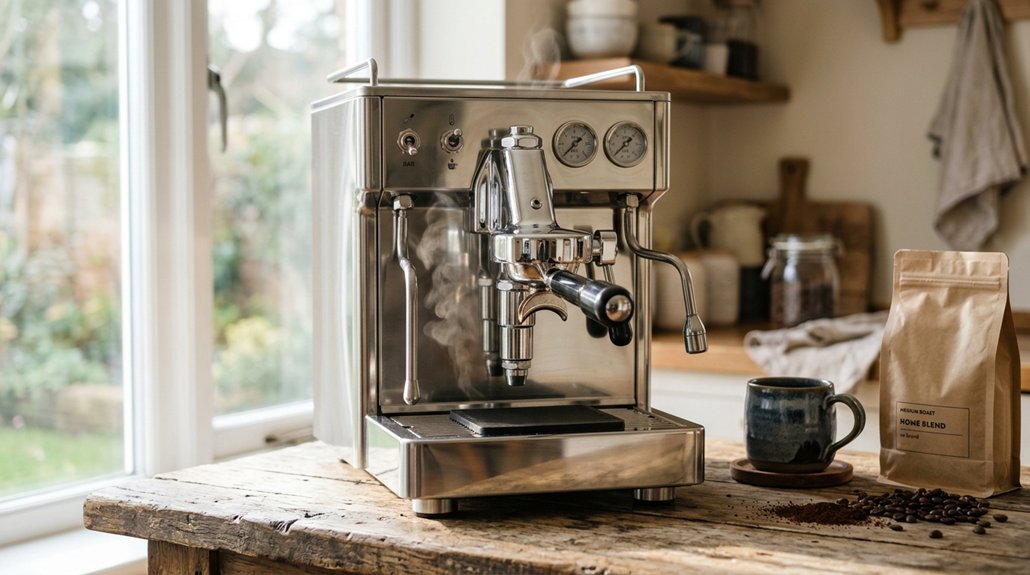


You’re looking at anywhere from $30 for basic steam models to $2,000 for home setups with built-in grinders and stable temperatures.
Commercial machines start around $6,000.
The real question isn’t just the upfront cost, though.
You’ll need to factor in a quality grinder, water filters, and regular maintenance to get decent results.
Before you decide what fits your budget, you should know which features actually matter for your daily routine.
Home Espresso Machines: $30 to $2,000 Cost Breakdown
How much should you expect to spend on a home espresso machine? You’ll find options ranging from $30 to $2,000, with each price tier offering different capabilities. At the low end, $30–$50 models use steam pressure instead of motorized pumps, which limits your extraction quality. Mid-range picks around $500 deliver what many call “cafe-caliber” results.
You’ll need to pay more for greater convenience. A $2,000 machine costs a hefty sum, but you’re getting faster heating, better automation, and advanced grinding features. For full automation, splurge on models like the Breville Oracle Jet, which grind, dose, and tamp automatically across 45 settings.
The Breville Barista Express, tested at 12.4% TDS and ~18.6% extraction on a Costco Kirkland Colombian roast, shows what mid-range home espresso machines can achieve without commercial espresso machine size or price.
Recommended Products

190℉–201℉ Precision Temperature Control- Adjust brewing temperature from 190℉ to 201℉ to match different coffee beans and roast levels. Achieve balanced espresso with rich chocolate notes or bright fruity acidity—just like a professional barista.

【All-in-One Home Barista Experience】- This Spacekey espresso coffee machine combines a built-in conical burr grinder, a 20-bar professional pump, and a powerful steam wand. Go from whole beans to a perfect espresso, creamy latte, or refreshing iced coffee in minutes. Everything you need for a complete home café experience. Perfect for both beginners and enthusiasts.

【All-in-One Café Experience】 From classic espresso to creamy cappuccinos, velvety lattes, refreshing cold brew, and bold Americanos — craft your favorite coffeehouse drinks at home. Dual shot options (single or double) let you customize strength to match your mood and energy needs.
Why Cheap Espresso Machines Can’t Make True Espresso
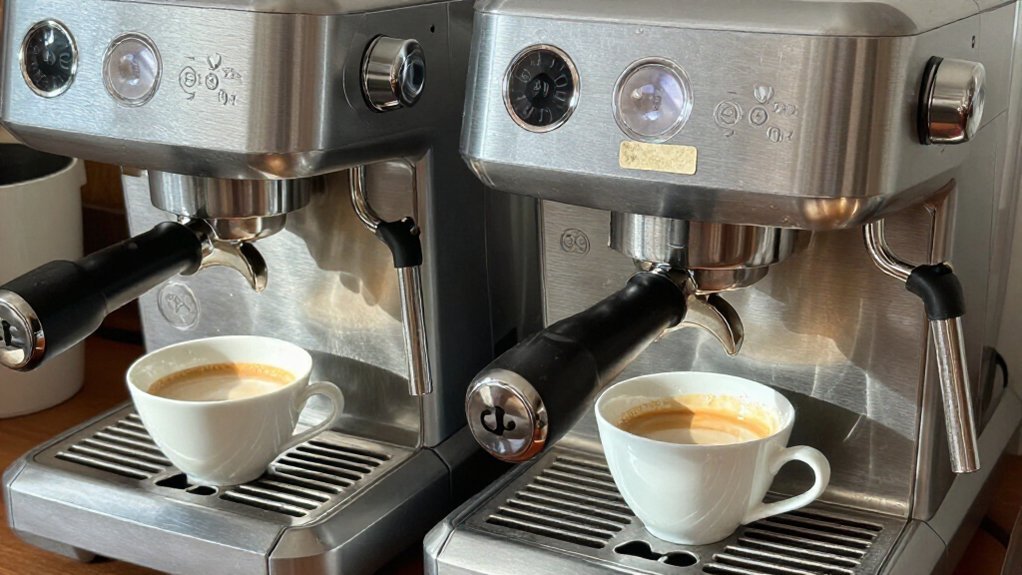
You won’t get real espresso from cheap machines because they use weak steam pressure or small pumps that can’t hit the right heat and force, so your drink ends up tasting more like strong coffee from a stovetop pot instead. Even if it looks right, the shot usually misses the proper strength range, around 18% to 22% extraction, which leaves you with thin, sour, or watery results.
Pair this with poor grinder performance, and you’ll find it’s nearly impossible to get steady, repeatable shots without spending closer to $500 or more for better temperature control and pressure stability.
Recommended Products

The Breville Temp Control Milk Jug includes an integrated thermometer indicator strip to help you texture milk to the optimum temperature range; Upgrade your cappuccinos, lattes and cortados
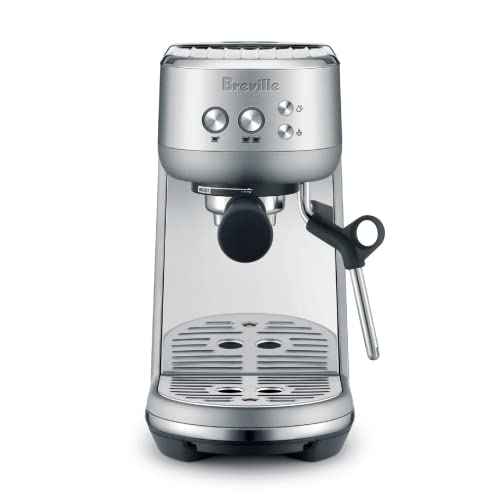
MICROFOAM MILK TEXTURING: Cappuccino maker and latte machine has an automatic steam wand allowing you to adjust milk temperature and texture, creating barista-quality microfoam for latte art at home
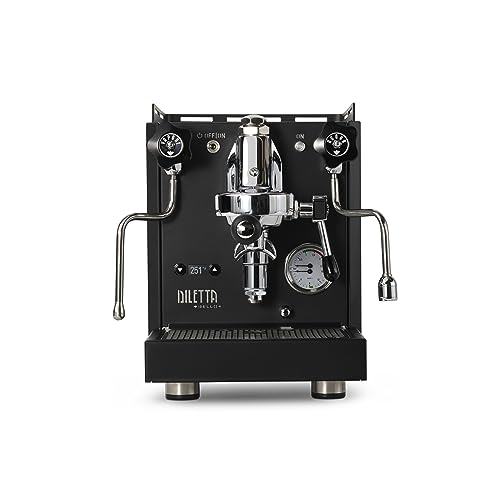
PID Temperature Control - View and adjust your steam boiler temperature quickly with the front-mounted PID screen.
Pressure and Temperature Control
Because true espresso needs steady pressure and temperature, cheap machines often fall short where it matters most. You can’t get real espresso without pressure and temperature control that stays stable from shot to shot.
When you use a low-cost machine, you’re likely getting moka-pot-like results instead. These units use steam or mimic pressure, but they don’t deliver the real thing. Balanced espresso extraction lands in the 18% to 22% range, and that depends on consistent conditions, not just strong, concentrated output.
The Breville Barista Express hit 18.6% extraction with TDS up to 12.4%, showing what proper control achieves. You won’t find a heat exchanger in budget models. Better heating systems, like the Breville Bambino Plus’s ThermoJet, reach and hold brewing conditions faster and more consistently than cheap options.
Grinder Quality Matters
Pressure and temperature control gets you only halfway there, because the grinder shapes what actually ends up in your cup. You need a quality burr grinder to produce a consistent fine grind size, or you’ll ruin extraction even on better machines. Cheap grinders add uneven particles, which throws off your shot completely.
In testing, high-quality espresso reaches around 18.6% extraction with up to 12.4% TDS on machines like the Breville Barista Express. Poor grind consistency makes hitting that range nearly impossible. Many higher-end systems, including the Breville Oracle Jet with its Baratza European Precision Burr, use smart dosing to keep shots balanced.
Even when your machine advertises 9-bar pressure, like the Breville Bambino Plus, weak grinder quality still leaves you with thin, sour, or under-extracted results. You can’t skip this step.
Commercial Espresso Machine Prices: Entry to Flagship
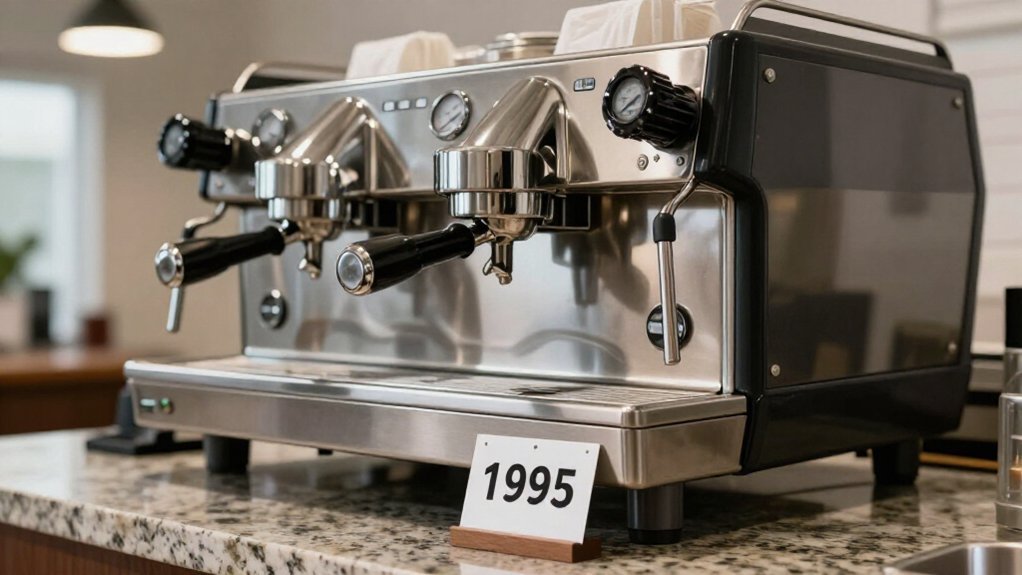
If you’re opening a café or upgrading your current setup, you’ll find commercial espresso machines span a wide price range based on size, boiler setup, and brand reputation. Entry-level commercial machines often start with single-group models, while automatic espresso machines and multi-group options push costs higher.
Mid-range choices include 2, 3 group dual-boiler systems, like Sanremo’s Zoe 2 Group at $6,800 and Zoe 3 Group at $8,000. Higher-end 2, 3 group models run steeper, such as Sanremo’s D8 at $9,900 for 2 Group and $12,950 for 3 Group, plus Rocket’s RE Doppia 2 Group at $13,000. Flagship tiers jump further, with La Marzocco’s Linea Classic S 2 Group ranging $12,730 to $16,670.
Your budget planning must weigh boiler type against workflow needs and peak hourly output.
Recommended Products

Make Your Favorite Espresso Coffee At Home: The CASABREWS coffee machine with milk frother allows you to prepare all your favorite espresso-based coffees. You can enjoy a barista-brewed latte, cappuccino or macchiato at home. Stainless steel appearance, stylish and durable, ideal for any size kitchen. This compact espresso coffee maker is perfect for home or office use
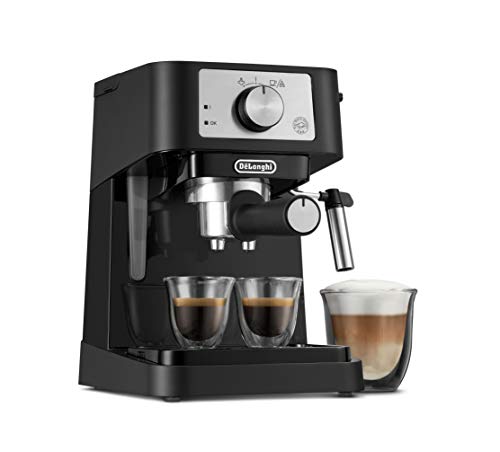
Please refer to user guide or user manual or user guide (provided below in PDF) before first use

Make Your Favorite Espresso Coffee At Home: The CASABREWS coffee machine with milk frother allows you to prepare all your favorite espresso-based coffees. You can enjoy a barista-brewed latte, cappuccino or macchiato at home. Stainless steel appearance, stylish and durable, ideal for any size kitchen. This compact espresso machine is perfect for home or office use
Match Your Machine to Daily Drink Volume
You should size your espresso machine by peak hourly demand, not total daily volume, so your group count matches real rush-hour throughput.
A 1-group machine fits up to about 50 drinks per day, while a 2-group covers most independent cafes up to 150 to 200 drinks daily. Choose a 3-group when you are above 150 to 200 drinks per day, or when busy periods would bottleneck a two-group workflow.
Peak Hour Demand
Often, cafe owners size their espresso machine by total daily drinks, but that misses the real problem. You need to plan for peak hourly demand, since that’s when bottlenecks break your workflow.
A 2-group machine handles about 150 to 200 drinks daily, which works for many independent cafes. If your rush hour pushes past that, you’ll need a 3-group machine to keep lines moving.
You should also think about boiler type. An HX boiler lets you brew and steam at the same time, which smooths out busy periods. For higher volume, dual or multi-boiler setups give more consistency.
Match your group count and boiler to your actual peak hour demand, not your daily total, and you’ll avoid the costly mistake of an underpowered bar during your money-making hours.
Daily Volume Thresholds
Peak hourly demand tells you how many groups you need, but daily volume still gives you a useful starting point for narrowing your options.
If you expect up to about fifty drinks per day, a 1-group commercial machine will handle your load. Most independent cafes fall into the 150 to 200 drinks per day range, and you’ll want a 2-group machine for that volume.
Once you push past that range, busy periods can bottleneck, so you’ll need to step up to a 3-group commercial machine.
Use these daily thresholds to estimate your size category, then check your peak hour numbers to confirm the right fit. After that, compare heat exchange and dual-boiler or multi-boiler options, so you get the consistency and workflow your daily output demands.
Heat Exchanger vs. Dual Boiler: Cost and Performance Tradeoffs
Choosing between a heat exchanger and a dual boiler espresso machine means weighing what you’ll spend against how smoothly your cafe runs. You’ll need to match your boiler setup to your daily pace and your budget.
- Heat exchanger machines cost less up front, and you’ll brew and steam at the same time from one large boiler.
- Dual boiler machines give you separate temperature control, so you’ll get steadier shots and faster recovery between orders.
- You’ll find heat exchanger models fit moderate volume well, while dual boiler setups handle busy rushes with less waiting.
- Specialty cafes usually pick dual boiler for consistency, but you’ll save money with heat exchanger if your volume stays moderate.
If you’re switching often between milk drinks and rapid espresso pulls, you’ll usually find the dual boiler’s quicker recovery worth the extra cost.
Recommended Products

SUITABLE FOR MOST OF BREVILLE MACHINES - Well -designed for all Breville machine models: BES980XL, BES920XL, BES900XL, BES860XL, BES870XL and BES840XL infuser espresso machine, BKC600XL and BKC700XL gourmet single cup brewer

【COMPATIBLE MODELS】Water Filter for Breville Espresso Machine Barista Touch BES880, Barista Touch Impress BES881, Breville Barista Pro BES878, Breville Oracle Touch BES990BSS, Breville Oracle BES980, Breville Dual Boiler BES920, Part Number # BES008WHT0NUC1

Fits All Gaggia Super-Automatics except Syncrony Logic
Built-In Grinders for Espresso Machines: Worth It?
How much time are you willing to spend on each shot? Built-in grinders save you minutes by grinding, dosing, and sometimes tamping automatically.
Models like the Breville Barista Express and Oracle Jet handle these steps for you. The Oracle Jet uses an integrated Baratza European Precision Burr grinder with 45 grind settings, plus milk-matrix customization. This helps you maintain consistent results when your coffee beans change.
You’ll find built-in grinders especially convenient for at-home espresso. They let you dial in easily without a second machine cluttering your counter.
However, if you want more control, grinder-less options like the Breville Bambino Plus require a separate dedicated grinder. For cafe-style consistency with multiple users, integrated dosing and tamping reduce variability, but you still need proper water and maintenance.
Recommended Products

MANUAL HAND-TEXTURED MICROFOAM: The powerful steam wand on this cappuccino maker and latte machine is designed to quickly turn milk into smooth, flavorful microfoam for creating latte art at home

40 Grind Settings, Less Mess – Dial in different coffee beans with 40 grind settings and precise 0.5-second dosing. The 40mm conical burr delivers consistent grounds, while the anti-static system helps reduce clinging and countertop mess

【Barista-Level Espresso Experience at Home】: The Espresso Machine with Grinder helps you brew rich, café-quality espresso and handcrafted drinks in minutes. With a semi-automatic brewing system and integrated milk frother, you can easily create lattes, cappuccinos, macchiatos, iced coffee, and more just the way you like. Designed with a modern black finish and compact footprint, it fits perfectly in any kitchen, office, or coffee corner—bringing professional taste and style into your daily routine.
Hidden Costs Every Buyer Should Budget For
The sticker price on an espresso machine is just the beginning, and you’ll want to plan ahead for the extras that add up fast. Hidden costs pile up quickly when you overlook the full picture.
You’ll need a commercial-grade grinder and water filtration, since pairing these protects your gear and improves shot quality.
Serviceability matters, so check parts availability and local support, especially for dual-boiler or multi-boiler setups where build quality affects long-term reliability.
Temperature control choices impact upkeep: dual boilers recover faster for busy workflows, while HX systems use one boiler with a separate brewing circuit, and both need regular attention.
Size groups for peak hourly demand, not daily totals, so one group handles ~50 drinks daily, two groups manage ~150–200, and three groups cover above that.
Factor in dial-in time and maintenance routines, like cleaning the shower screen and running water-only cycles, to reduce buildup and keep extraction consistent.
Recommended Products

High-Quality Replacement – Designed to be fully compatible with Rancilio Silvia espresso machines for reliable performance.

ENJOY CAFÉ-QUALITY ESPRESSO: Experience the bold, rich flavor of homemade espresso and skip long café lines with the CraftBrew Digital Espresso Maker! A strong 15-BAR pump and a built-in milk frother make it easy to brew cappuccinos and lattes right in your own kitchen.

AUTOMATIC MICROFOAM MILK TEXTURING: Auto steam wand allows you to adjust milk temperature and texture, delivering barista-quality microfoam; Create latte art at home with this versatile cappuccino maker and latte machine
What to Look For Beyond the Price Tag
Once you’ve mapped out the hidden costs, it’s time to weigh what actually matters in daily use. Boiler configuration shapes your daily workflow more than you’d expect. Heat exchange machines let you brew and steam at once, but dual boilers give you tighter temperature control and faster recovery between shots. For higher volume, multi-boiler setups keep each group head stable.
Match your group heads to peak hourly demand, not total daily count. One group handles roughly 50 drinks per day, two groups manage 150 to 200, and three groups solve bottlenecks during busy rushes.
Don’t overlook your grinder and water setup. You’ll need precise grind settings for consistency, plus filtration to protect your investment. Check local parts availability and build quality before you decide.
Recommended Products

Milk Frothing System: Our espresso machine with milk frother has a powerful steam wand, so you can texture creamy, rich microfoam milk to create amazing milk foam art and enhance the flavor of your brews. Awaken your inner barista and create your own unique milk foam art. Don't pass us by if you are looking for an excellent espresso coffee makers steel appearance, stylish and durable, ideal for any size kitchen. This compact espresso coffee maker is perfect for home or office use

Make Your Favorite Espresso Coffee At Home: The CASABREWS coffee machine with milk frother allows you to prepare all your favorite espresso-based coffees. You can enjoy a barista-brewed latte, cappuccino or macchiato at home. Stainless steel appearance, stylish and durable, ideal for any size kitchen. This compact espresso coffee maker is perfect for home or office use

Milk Frothing System: Our espresso machine with milk frother has a powerful steam wand, so you can texture creamy, rich microfoam milk to create amazing milk foam art and enhance the flavor of your brews. Awaken your inner barista and create your own unique milk foam art. Don't pass us by if you are looking for an excellent espresso coffee makers steel appearance, stylish and durable, ideal for any size kitchen. This compact espresso coffee maker is perfect for home or office use
Get Expert Help Sizing Your Espresso Setup
Because sizing an espresso machine wrong will cost you thousands in lost sales or wasted equipment, you’ll want to get the numbers right before you buy. Use peak hourly demand, not daily totals, to pick your group count: one group handles ~50 drinks daily, two groups manage 150–200, and three groups prevent bottlenecks during busy periods.
Size by peak hour, not day: one group for ~50 drinks, two for 150–200, three to kill bottlenecks.
Your boiler choice shapes daily workflow. Heat exchange machines let you handle brewing and steaming at once through one boiler, while dual boilers speed recovery with separate tanks. For the best consistency, multi-boiler setups give each group its own heat source.
Match group count to peak hourly output, not full-day volume. Select HX or dual boilers based on speed needs. Consider multi-boiler systems for tested and reviewed high-volume lines. Budget grinders and filtration into your total spend.
Book a free 20-minute video consultation to review your menu, space, and service needs before you commit.

I've spent years obsessing over the details that make a house feel like a home — from the perfect bedding layers to a thoughtfully styled coffee corner. My focus is on modern, aesthetic home decor ideas that are beautiful, trend-aware, and actually achievable. Great style shouldn't require a big budget — just the right inspiration.
Follow on Facebook